 Writeboard
Sign in
Start free
Writeboard
Sign in
Start free
For agencies
Every tutor on the same whiteboard, every lesson kept
An agency's problem is not the whiteboard, it is what happens after: a tutor leaves and the lessons go with them, a parent asks what was covered and nobody can say, a safeguarding question needs a record. Writeboard keeps every lesson as a book the agency owns, with oversight that shows the shape of the work without opening anybody's pages.
Watch how a team runs it: short clips of the real product.
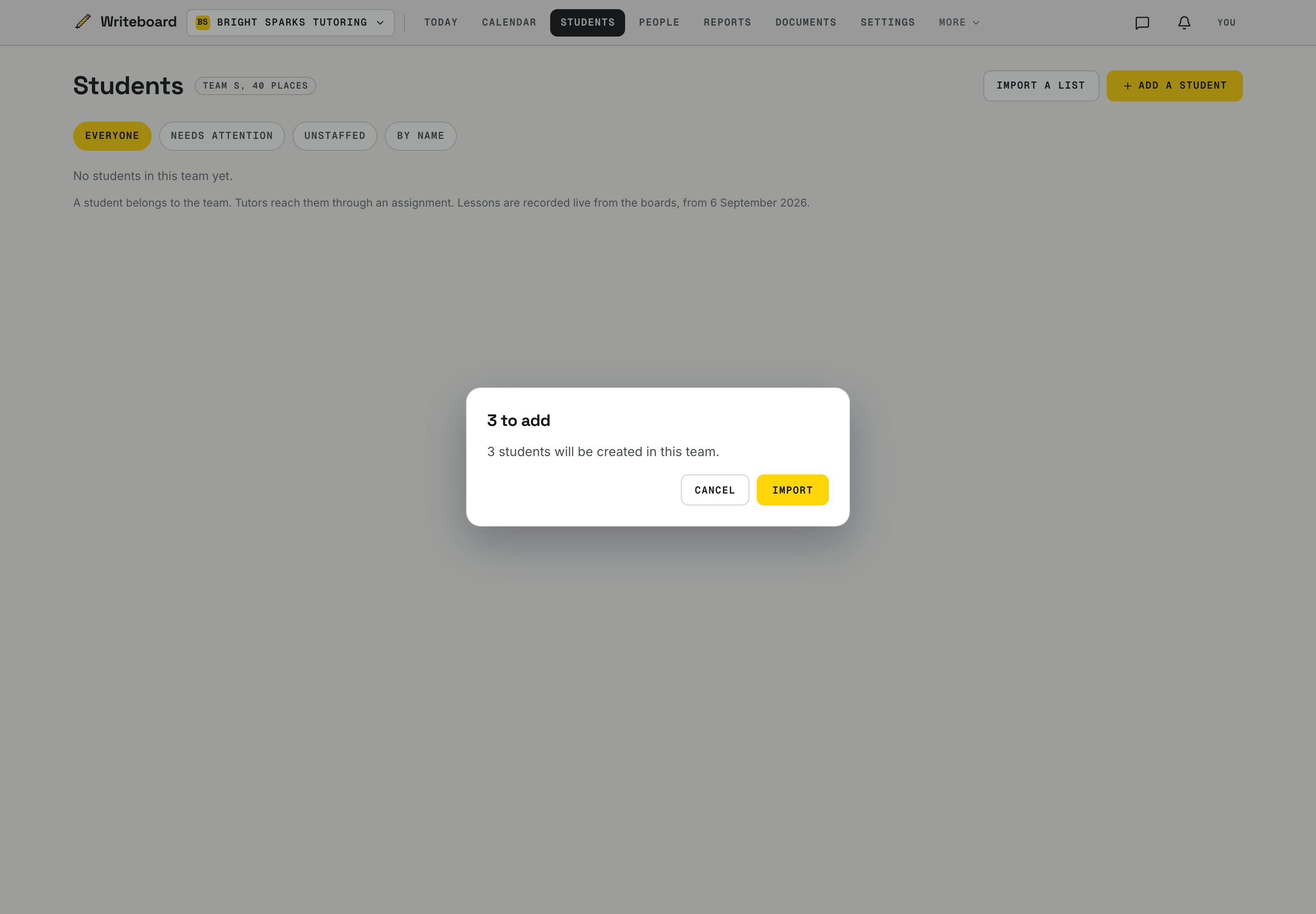
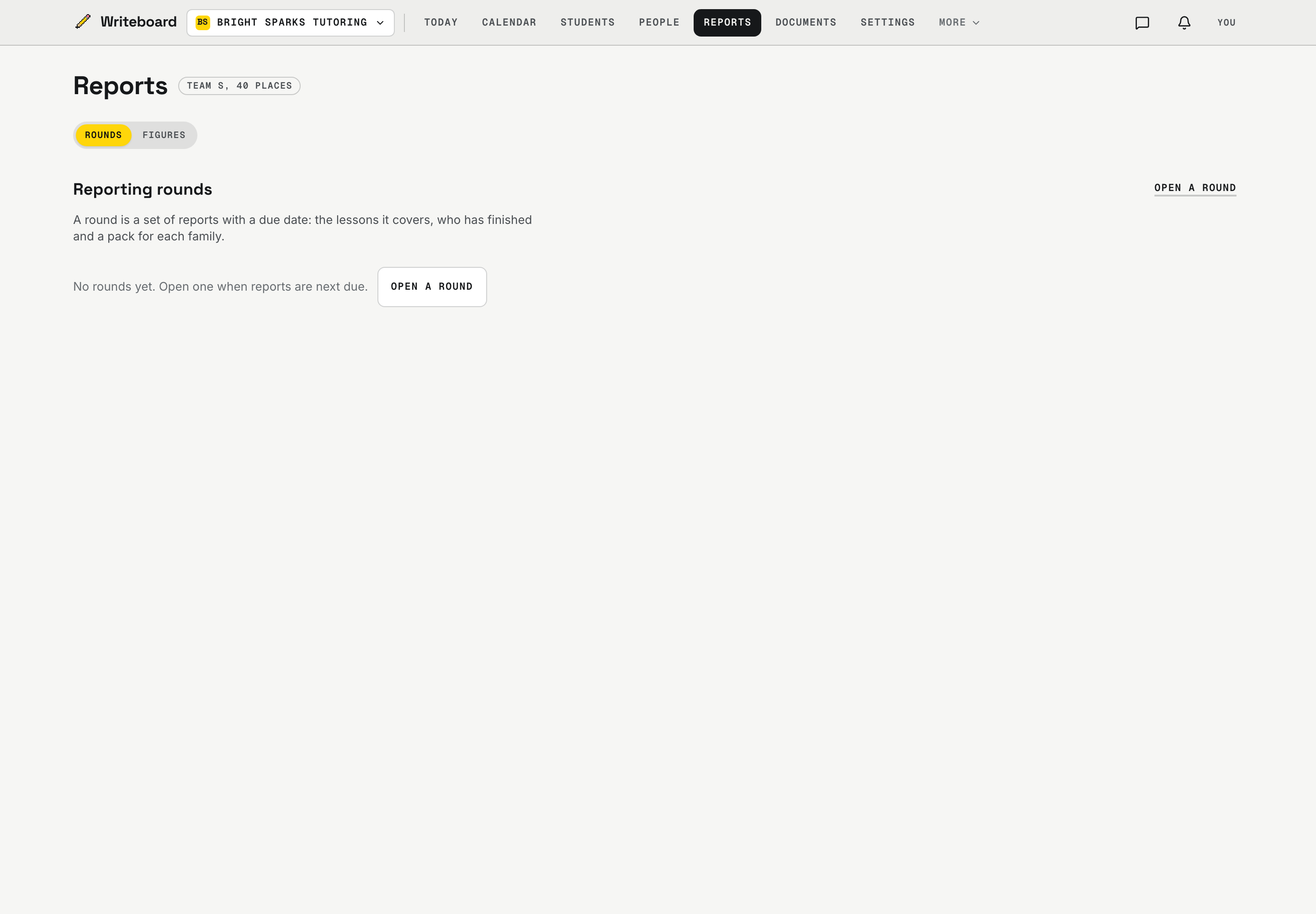
Updated 11 October 2026. Every screen shown is the real product.
The short answer
A team has admins, coordinators and tutors. The agency owns the students, admins put tutors on them, and a tutor reaches a student only through that. When somebody leaves, one screen asks who takes each of their students and whether their books go too. Coordinators watch how the work is going and cannot open a page of it. Priced by the students being taught, £39 a month to 40 of them, £89 to 120, £179 to 300, with tutors and coordinators never counted and never charged, invoiced with your purchase order number.
| Need | What Writeboard does |
|---|---|
| Continuity | Students, books and homework belong to the team, not to a tutor's account. Offboarding hands each student to a named colleague, with or without the leaver's books, and records both choices. |
| Oversight | A coordinator sees lessons, homework set and handed in, what is overdue and what has been marked, per student, with no way into the work. An admin can open a book, and the tutor who owns it sees that they did. |
| Several tutors per student | Maths on Monday and physics on Thursday, on one student and one sign-in. Each tutor's books are private to them unless they hand one over; the student sees all of their own. |
| Starting up | Paste a spreadsheet of tutors and one of students. You see what it will do before it does it, one bad line stops the file, and people without accounts are invited and join when they sign up. |
| Scheduling | A weekly lesson per student: the team's week in one screen, term dates typed once so half term empties itself, and the clocks going back never moving anybody's four o'clock. A tutor who cannot make one says so with a reason and it lands in the admin's queue with the time left on it; one tap hands it to a colleague, who gets the student with it. Ten minutes before, the lesson arms itself into one button. |
| Reporting | A term per student and per tutor: lessons, time on the board, set, handed in, on time, marked. Downloadable as a spreadsheet, with a filter for who needs chasing. |
| Safeguarding | Two-factor sign-in is required before anybody can be made an admin or a coordinator. Tutors confirm their authority before their first invite. A student's sign-in holds no email and no tracking; the record you keep on a student (date of birth, schools, results, documents) is visible only to the people who run that student, never from the student's own sign-in. |
| Data and exit | Export everything the team holds as one file, any time, without asking us. Erase a student for good on request. London hosting, encrypted backups, a published sub-processor list. |
| Cost | By students, in bands: £39 to 40, £89 to 120, £179 to 300. Tutors and coordinators never counted, never charged, so the bill follows your revenue line, never your payroll. Nothing metered by the hour, the paper or the gigabyte. |
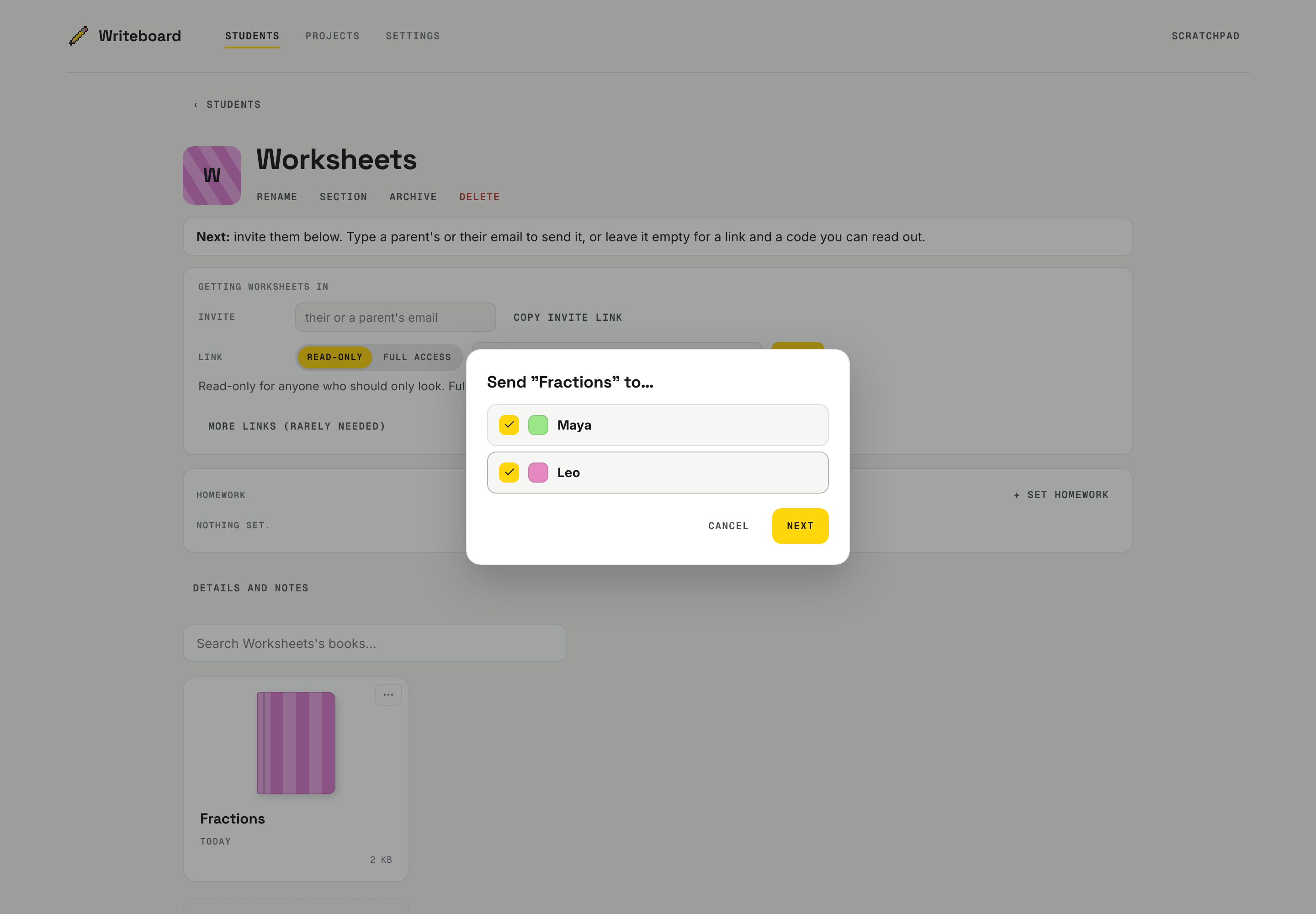
Watch the team run
What a team costs
Forty students: £39 a month. A hundred and twenty: £89. Three hundred: £179. Tutors and coordinators are never counted and never charged on any band, so the agency with six full-timers and nine part-timers pays exactly what the agency with six tutors pays: we price the teaching, never the people.
Hiring never moves the bill. Bramble bands by tutors: £40 a month to twenty of them, £90 to thirty, so their twenty-first hire costs an agency £50. Ours costs nothing, because a tutor is not the thing an agency earns with. Your bill moves when your roster does, the same direction your revenue moves, and archiving a finished student keeps every page and frees the place. Source: about.bramble.io, checked 2 September 2026.
Two plans
Team is everything above: the boards, the roster, homework, marking, oversight, offboarding, the calendar, the term report and the exports. £39 a month to forty students, £89 to a hundred and twenty, £179 to three hundred.
Agency adds the paperwork nobody should have to remember. Every student gets a record (their school, their board and tier, what they are working towards) and a file for their school reports, mock results and consent forms, with who may see each one set on it. Progress reports draft themselves overnight from the lessons that actually happened, so a tutor finishes one in two minutes rather than starting from an empty form, and you get the list of who owes one. Your own templates and policies live on a shelf the whole team can reach, and a template can set the headings your reports ask for. £79 a month to forty students, £189 to a hundred and twenty, £379 to three hundred.
The comparison that matters is not our two plans against each other. It is Agency against what an agency pays today for a whiteboard plus reporting: Bramble alone is $29 to $45 per user per month, so twenty users is $580 or more, and Lessonspace meters by the hour after the first hundred. Ours is flat, and the gap widens as you grow.
Founding agencies: the first three agencies get their first term free, their band price locked for two years, and onboarding done with us personally, in exchange for a case study, a testimonial and a monthly call in their first term. Write to us.
What would your agency pay?
Drag the sliders. Ours follows the students; tutors never move it. Bramble's follows the tutors; students never help it. BitPaper is an estimate from their metered rates, because a metered bill cannot be known in advance, which is rather the point.
Writeboard Team
£39
a month, exactly. Priced by the students being taught; tutors and coordinators are never counted and never charged. Nothing metered.
Writeboard Agency
£79
a month, with the student record, the school files and the reports drafted overnight. Same bands, same rules.
Bramble
£40
their published band for up to 20 tutors. No homework, no marking, no coordinator role.
BitPaper
≈£300
estimated: $50 a month plus $1 a paper and $0.20 a call hour. Grows with every lesson you teach.
The BitPaper estimate assumes four lessons a student a month, one paper and one call hour each, at $1 = £0.78. Neither rival offers homework with marking, a term report, offboarding that keeps the students, or a free oversight role. Sources: about.bramble.io, bitpaper.io, checked 2 September 2026.
What is not built yet
We would rather you heard it here than found out in week three. Paying by card is not self-serve for teams: we invoice you, with your purchase order number on it. Single sign-on with Google Workspace or Microsoft does not exist, and is not on a near roadmap. Student counts are shown on your team page, and going past a band puts a notice there and follows onto the invoice, but it never locks anybody out: a roster count is not a reason to stop a child's lesson. Pooled storage is only checked when a file is added: a full pool refuses the upload and nothing else, so no lesson ever stops on a number. Setting a team up is something we do with you rather than a signup form.
How it compares
BitPaper charges companies $50 a month plus $1 a paper and $0.20 a call hour; Pencil Spaces charges by the session hour, from $0.40 an hour. Both put the call inside the board. Writeboard does not do calls; it does the record, and it charges by the students taught, so an agency can budget a year in advance. Sources: bitpaper.io, pencilspaces.com, checked 2 September 2026.
Questions agencies ask
How is a team priced?
By students, in bands, the way tutoring earns: £39 a month to 40 students, £89 to 120, £179 to 300, and beyond that we price it with you. Tutors and coordinators are never counted and never charged, so bring every part-timer. Archiving a student you have finished with keeps every page and frees the place. Nothing is metered by the hour, the paper or the gigabyte. Invoiced monthly with your purchase order number on it.
Who owns the data when a tutor leaves?
The team. Students, books and homework belong to the agency, not to the tutor's account. Removing somebody asks, for each of their students, who takes them on and whether the leaver's books go with them, and both answers go on the team's record.
Can a manager see what happens in lessons?
A coordinator sees that the work happened and never the work itself: lessons, homework set and handed in, what is overdue, what has been marked, when each student was last on a board. There is deliberately no way in from that screen. An admin can open a book, and the tutor who wrote it sees on the team's record that they did.
Can two tutors share a student?
Yes, and each tutor's books stay their own. A maths tutor and a physics tutor work with the same student, see each other on the team page, and cannot open each other's pages. A book can be handed to a colleague deliberately. The student sees all of their own books, whoever set them.
How do we get forty tutors started?
Paste a spreadsheet of email addresses and roles, and another of students with their tutor and any tags. You see exactly what it will do before it does any of it, and a single bad line stops the whole file and names the line. People who have no Writeboard account yet are invited and join the moment they sign up.
What do we get for reporting?
A term at a time, per student and per tutor: lessons, time on the board, homework set and handed in, how much of it arrived on time, and marks. Downloadable as a spreadsheet. There is a filter for the students worth chasing: homework missed, work handed in and never marked, or nobody seen for a fortnight.
How do we get our data out, or erase a child's record?
An admin exports everything the team holds as one file, whenever they like, without asking us. A student can be erased for good on request: their books, pages, homework and sign-in, gone, with the admin typing the name to confirm. A safeguarding hold outranks an erasure request.
What is not built yet?
Paying by card: teams are invoiced, and we set that up with you. Single sign-on with Google Workspace or Microsoft: not built, and we will say so rather than put it on a roadmap slide. Going past a student band puts a notice on the team page and the next invoice, never a lockout. A full storage pool refuses new uploads and nothing else. No lesson ever stops on a number.
What happens if Writeboard shuts down?
Every account gets at least 90 days' notice by email, exports stay available to the last day, and the data is deleted after. The wind-down is a written procedure, not a promise.
Where is the data held and who processes it?
On a server in London, with encrypted backups in the European Union, held by two separate companies. The sub-processor list is published on our privacy page; a data processing schedule and the DPIA for children's data are available on request.