 Writeboard
Sign in
Start free
Writeboard
Sign in
Start free
For parents
What a parent can see
Your child's tutor uses Writeboard as the whiteboard for their lessons. Every lesson is kept as pages in a book, and there are three ways for you to see what was done, none of which needs an account or a password.
Watch what a parent sees: short clips of the real product.
Updated 17 September 2026. Every screen shown is the real product.
The short answer
Ask the tutor to add you as a parent or guardian. You get a link of your own: the next lesson, the progress reports shared with you, the notes the tutor writes after a lesson, and, if the tutor allows, the books exactly as they are, page by page, with the homework marked on them. You choose which of those you want emailed; every email carries a link that stops it. The tutor can also export any chapter or the whole book as a PDF and send it to you. And your child's own shelf shows the homework that is set, its due date and whether it has been handed in.
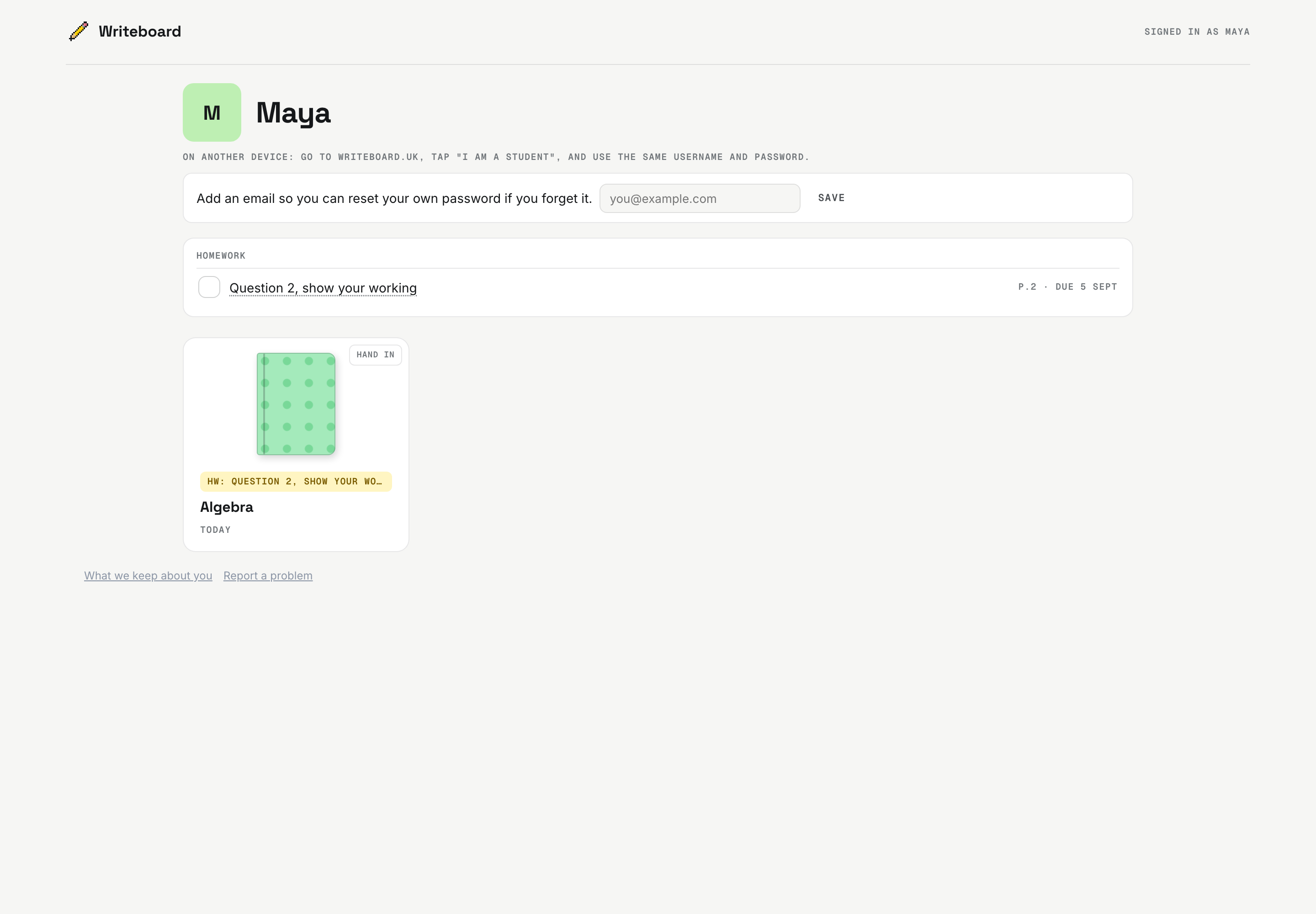
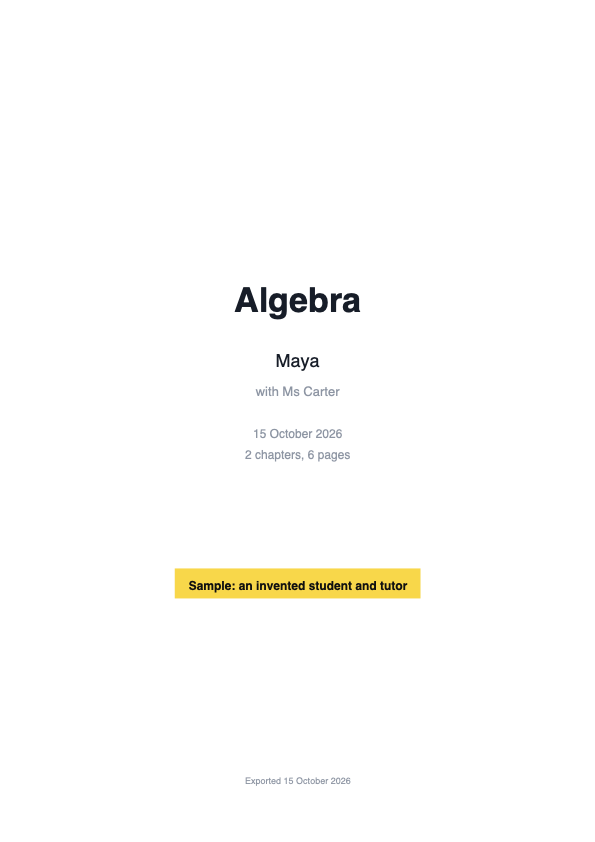 See what a parent getsA real export: a contents page, then every lesson in order, as one PDF. The student and tutor are invented.
What is stored about your child
| Kept | Not kept |
|---|---|
| A first name or nickname the tutor typed | Anything the tutor did not type or upload |
| A username your child chose, and a password we cannot read | An email on the child's account (optional, for resets only) |
| The lessons: pages, ink, worksheets, homework, and the tutor's note on a lesson if they write one | Where they are, what they do online, anything from other apps |
| Where the tutor or their agency keeps a record: date of birth, school, subjects and results, your contact details, progress reports, documents such as consent forms. Seen only by the people who run the lessons, never from your child's sign-in | Adverts, trackers, time-on-app nudges |
| The date the tutor confirmed their authority to add them |
The data sits on a server in London with encrypted backups. The tutor is the person responsible for what is written; we store it for them and never publish it. You can ask for a copy or for deletion at any time, through the tutor or by writing to hello@writeboard.uk. The full notice is at /privacy and the version written for children at /privacy/students.
If something is wrong
Tell the tutor first. If you would rather not, or the concern is about the tutor, write to hello@writeboard.uk; we acknowledge within 2 working days and have a written safeguarding procedure. In an emergency call 999.
Questions parents ask
Can I see my child's lessons?
Yes, with a link of your own. The tutor adds you as a parent or guardian and you get a link that needs no password: the next lesson, the reports shared with you, the notes the tutor sends, and the books to read if the tutor allows. Ask the tutor for it.
What does Writeboard store about my child?
A first name or nickname the tutor chose, a username the child chose, a password hash, an optional email an invite went to, and the lessons themselves. If the tutor or their agency keeps a record, it can also hold a date of birth, school, subjects and results, your contact details, progress reports and documents such as consent forms; only the people who run your child's lessons can see it. No location, no tracking, no adverts. The plain-words version is at /privacy/students.
Can I get a copy, or have it deleted?
Yes. Ask the tutor, who can export everything as one file, or remove the student, after which the lessons wait 30 days and then go. Ask the tutor or their agency to erase the record too, or write to hello@writeboard.uk and we answer within a month, usually within days.
Does my child need an email address?
No. A student signs in with a username and password. An email is optional and used only to send a password reset.
Can my child tick off part of the homework?
Yes. Each part of a homework is a tick on their shelf, with a picture of the work; the last tick hands it in. The tutor sees how far along it is.
How do I know how they did?
Your link shows the marks on the page when the books are shared with you. When the tutor gives marks out of a total, the homework carries a score, and the child's shelf shows it too.